Not all heat pumps are built the same. If you're shopping for one, here's what actually separates a well-made unit from a mediocre one.
Start with the compressor
The compressor is the heart of the system. Look for DC inverter technology rather than fixed-speed on/off compressors. A DC inverter adjusts speed hertz by hertz to maintain peak efficiency, rather than running at full power or nothing.
That's what delivers the energy savings and the stable temperature control.
For cold climates, check if the unit uses Enhanced Vapor Injection (EVI) technology. EVI compressors maintain heating performance at very low ambient temperatures — some units can operate down to -30°C or even -35°C.

Check the efficiency numbers
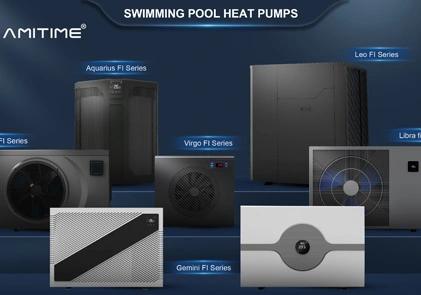
SCOP (Seasonal Coefficient of Performance) tells you how efficiently the unit heats across an entire season. Higher is better. Some good residential units reach SCOP values of 5.0 or above. The Libra Air FI series, for example, shows SCOP ranging from 7.5 to 7.9 depending on the model.
But don't just look at the headline number. Ask for COP ratings at different operating conditions — like A7/W35 and A7/W55 — to see how the unit performs under real-world loads.

Examine the heat exchanger design
The evaporator and condenser are where heat transfer happens. Some manufacturers use innovative fin designs to improve efficiency. For instance, a ripple fin design on the evaporator can increase heat exchange efficiency by up to 30% within the same footprint.
For pool heat pumps or saltwater applications, a titanium heat exchanger is a strong indicator of quality — it resists corrosion far better than standard copper or stainless steel.
Look at the testing infrastructure
A manufacturer that invests in real testing is a manufacturer that stands behind its product. Quality manufacturers operate multiple certified labs — AMITIME, for example, has 35 professional heat pump laboratories meeting TÜV and Intertek standards, including a -45°C ultra-low temperature lab that can simulate environments from -45°C to 85°C.

Pay attention to noise control
A well-built heat pump runs quietly. Good manufacturers use multiple noise reduction strategies: vibration-damping rubber feet, buffer bases, multi-layer soundproof enclosures, and optimized expansion valves that eliminate abnormal whistling sounds.
Some high-end units can achieve noise levels as low as 29 dB(A) in silent mode.
The bottom line
Quality comes down to three things: the compressor, the heat exchanger, and the testing that went into the design. If a manufacturer can show you real test data, third-party certifications, and the engineering behind their products, you're probably looking at a well-made machine.


 English
 Deutsch
 français
 Español
 italiano
 Türkçe
 Svenska
 Afrikaans
 русский
 العربية
 日本語
日本語